Tuesday, 22 January 2013

Rest Your Shield Now and Again

Remember to rest your shield now and again
It's a rather busy time at the moment with several other writing projects on the go, and I spent my weekend toiling away to meet a scholarly publisher's deadline instead of digging through the boxes of bookplates and other book related ephemera that patiently awaits my attention.  As I'm unlikely to get away from work to write up a proper blog this week, I thought I'd just share a bookplate with you that I've currently set on my desk.  This little ex libris reminds me that at some point everyone should rest their shield for a moment and take a break.  As one who researches and writes extensively every day in my career, it's easy to forget this.  It's a good reminder for me - it's good for your physical and mental health, and gives you the energy needed to return to the work at hand.

I've liked this ex libris for other reasons as well, and appreciate its unconventional approach to displaying a family coat of arms.  If you have a bookplate that makes you think, please feel free to share it with me.  Perhaps we can post some other people's favourites up here on the site.  Until next time....    

Saturday, 12 January 2013

Book Seller Labels and Binder's Tickets 1

A sample of bookbinder tickets and seller's labels
Ex Libris are often described as miniature works of art, but after I began collecting them I discovered that things can get even smaller.  Enter the stationer's and bookseller's label, and the bookbinder's ticket.

These mini tabs are often found in the bottom or top corner of the gutters of the pastedown, or on the endpapers, of many older books and were used by binders and sellers as a way of advertising their part in bringing a book to market.  Some sources suggest they saw first use in the 18th century but an exact date of introduction seems less certain. Still, they constitute an important book artifact and offer us great insight into the book trade of years past.  Whether your interest is books or local history, there's much research enjoyment to be founds in these tiny treasures.

labels and tickets in all shapes and sizes
Admittedly, when I first started acquiring these it was more by accident than by design and I didn't know (and still don't know) much about the ones in my collection.  Not surprisingly, however, there are a couple of excellent websites out there where one interested in these things can learn a whole lot more.  My favourite references on the topic to date are Bookseller Labels and Seven Roads.  Each of these websites offer a tremendously rich resource for someone looking to get a better understanding of the use of tickets and labels.  As well, both sights have large picture galleries to browse.

I seem to have amassed quite the pile of these things and am in the process of separating out the Canadian ones for my own collection.  I also need a way to store and present them. I thinking about putting them into an album, but does anyone have any ideas on how I might be able to display these?

Also, even after I've separated out what I want from the piles I'll be stuck with a large collection of old British, American and other international labels that I'll be looking to swap for Canadian bookplates, or perhaps, to sell to someone else who may appreciate them more than I will.  If labels are your thing, get in touch at the email above and I'll be glad to send you a photo of what there is on offer.  hopefully, these labels can find their way to a good home.  Until next time

Sunday, 6 January 2013

Bookplate Designer Sylvia Hahn (1911-2001)

Bookplate designer Sylvia Hahn
Happy New Year everyone, I hope you had a safe and enjoyable holiday season.

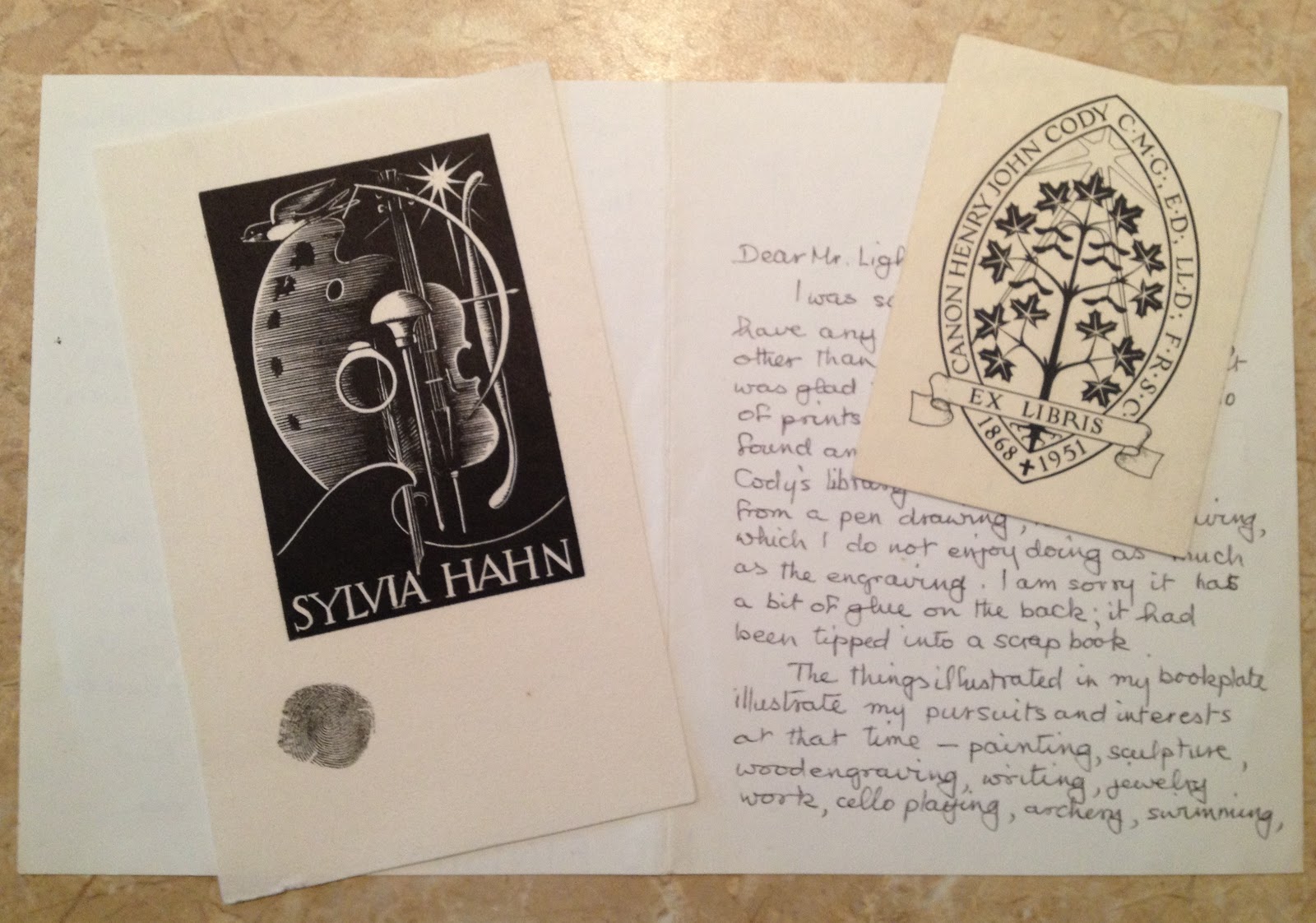
Occasionally in this hobby I come across little groups of letters and related bookplates like the one pictured here.  This particular lot consisted of two bookplates and a letter attributed to Canadian artist Sylvia Hahn.  Born in Toronto in 1911, she was an exceptionally talented and versatile craftswoman who was awarded the Governor General's Gold Medal for artistic achievement in 1932.  She then went on to a very successful career with the Royal Ontario Museum where she was a prolific painter, illustrator, engraver, designer, restorer, and writer.

Sylvia Hahn's personal bookplate
Hahn's design work included bookplates, which she often executed from wood engravings and pen and ink drawings.  A more complete biography of Hahn's extensive achievements may be found in the Canadian Women Artists History Initiative, but I'd like to include a short excerpt from the letter shown above (written in 1984), which offers some insight to Hahn's own bookplate design:
The things illustrated in my bookplate illustrate my pursuits and interests at that time - painting, sculpture, wood engraving, writing, jewellery work, cello playing, archery, swimming, astronomy, and the study of barn swallows.  I am afraid if I designed in again now the composition would be a bit emptier.  As one gets older it seems there is less time in a day for doing things!

She also pointed out that the medium employed on her own bookplate was wood engraving not wood cut:  "We engravers feel strongly on the subject - not that cuts aren't just as good, but they are different."


Hahn in her studio - date unknown
I feel lucky to have gotten this ex libris for my collection.  According to the letter, Hahn only made one printing of her bookplates and had run out of them save for this one that was tucked away "in my portfolio of prints and reproductions."

The other bookplate shown above was also designed by Hahn, for Canon Henry John Cody CMG, the 6th President of the University of Toronto.  I've already identified a few other bookplates designed by her as well, but further research is still needed before I can construct a complete catalogue of her ex libris work.

If you know of any other bookplates designed by Sylvia Hahn, I'd love to hear about them, just use the email above.  Otherwise, I encourage you to explore her work beyond her bookplates as well - her paintings and other illustrations show great talent and are an enjoyment.  Until next time...


Sunday, 30 December 2012

Canadian Bookplates 2012 Wrap Up

It'll be a few more years before my library looks like this!
As another year of the Canadian bookplates blog draws to a close, I took a bit of time this morning to look back through the 2012 posts as well as my bookplate hobby in general.  Like any pastime, there were ebbs and flows throughout the year as time permitted more or less collecting, cataloguing, and research.  Overall, however, I was very pleased with how things went and have derived a great pleasure so far from this pursuit.

As always, if you have questions about bookplates in your collection, or have something you wish to sell or trade, please do not hesitate to get in touch at the email above.  I'm always keen to hear from other collectors as well as those with a general interest in Canadian book culture, ephemera, ex libris, and library history.

I'd like to thank everyone who has visited the blog this year (we squeaked past 40000 views before year's end) and especially those who took time to leave a comment or two.  If you've enjoyed what you've seen so far, please consider becoming a follower of the site or take a moment or two to click on some of the links posted on the right.  Here you'll find a mix of resources and ads, both of which help support the site over the long term.

Coming in 2013

Thinking of some new year's resolutions, my main plan for 2013 is to simply keep the blog healthy with at least 4 posts a month.  Time permitting, I'd like to add more to the other pages on designers, bibliography, and libraries, but I also invite you to contribute anything you think may be of interest to everyone reading this blog.  Just email me your info and I'll edit and post it.  As for book reviews, the offer still stands if you have a publication you'd like to give wider attention to.

Since there hasn't been very many posts concerning ephemera lately I will also endeavour to include this more often in the coming year.  I actually have a good little collection of book and bookplate related ephemera, documents, correspondence, etc., and my first post of the new year will highlight some interesting correspondence I acquired this fall.

My other two main ex libris projects are 1) the design of my own bookplates, and 2) my ongoing research and writing of a new book on Canadian Ex Libris.  Both are progressing well and I expect to have some results to share in the coming year.

I hope everyone has had a safe holiday and has a Happy New Year.  Best wishes for success in 2013.  Until next year....


Sunday, 23 December 2012

Thomas Aylwin - Merchant of the Seven Years War


Modern day Rue Notre Dame, Quebec City
Bookplates offer a tremendous opportunity to study those men and women who laid the foundations of the country we live in today.  Thomas Aylwin, an English merchant who conducted trade in Quebec City after its capture by General Wolfe’s army in 1759-60, and then in Boston until the American revolution broke out, had this beautiful Chippendale armorial bookplate made for his bibliographic possessions. 

Aylwin was born in Romsey, Hampshire, England in 1729.  He pursued a merchant’s life and eventually established himself at Quebec City after its capture from the French by General Wolfe’s army in 1759-60.   As one biography of him noted, “he was doubtless among that set of merchants of whom Governor Murray said in 1764: they have resorted to a Country where there is no money, and . . . think themselves superior in rank and fortune to the Soldier and the Canadian.”  At Quebec City, Aylwin’s partner was Charles Kerr and the two men specialized in the retail sale of imported products including dry goods, foodstuffs, wine, hardware, stationery, and other merchandise. After Charles Kerr died in 1765, Aylwin carried on at Quebec until about 1769.  After that, records indicate he moved to Boston, where he continued to operate as a merchant until the outbreak of the American Revolution.  Along the way he had married Lucy Cushing, daughter of the US Supreme Court Justice William Cushing, on 11 September 1771.  Together they had three sons. 
Thomas Aylwin's book plate

Fleeing the outbreak of war, Aylwin returned to Quebec City with his family in 1776 and set up a new business on Rue Saint-Jean, later renting a house on Rue Saint-Joseph. On 23 October 1777 he bought two houses on Rue Notre-Dame, in the business district, from merchant and legislative councilor Thomas Dunn for £948.  Over time the range of products he advertised in the Quebec Gazette steadily broadened.  He died at Quebec City on 11 April 1791.  Throughout his life Aylwin seems to have enjoyed moderate prosperity, and the inventory made after his death reveals that he lived comfortably, though not in luxury.  Included in this inventory was the record of a library of some fifty volumes that included works of history, law, religion, and poetry, as well as business.

I secured Aylwin’s bookplate amongst a small collection of heraldry items I bought earlier this year.  Interestingly it was not listed in the famous Franks collection catalogue, but it was listed in the 1895 catalogue of Canadian bookplates assembled by Quebec Ex Libris authority Phileas Gagnon (G.4755 and G.S. Appx).  Given that his estate noted that Aylwin owned “some fifty volumes” I can’t help but wonder just how many of these bookplates have actually survived over the last 250 years.  Is this the last one?  Does anyone else have one of these in their bookplate collection?  If you do please let me know.  Until next time …

Monday, 17 December 2012

Lawrence Inglebert McMahon Bookplate

Who was he?
Ever since I first saw this bookplate in the Thomas Murray Collection I've been attracted to it.  It's a fabulous composition in a restricted space and it does a great job of focusing the eye on central scene.  If you look at it while, you might even find yourself wondering, "where did the reader go?"

Needless to say, I was very excited to have one turn in up in the old collection I just bought.  I've spent a bit of time researching the owner, but other than determining that he might have been an Irish immigrant to Canada around 1880 I've had no other luck so far.  A closer inspection of the plate itself revealed the initials 'Ph.K.' tucked under the face of the creature depicted a the bottom right.  Again, I've no idea who the designer might have been.

This is one of those bookplates that I would really love to be able to tell the story of.  It's obvious the owner cared enough about his library to adorn his books with a fine plate, and I'd be interested to hear from anyone who may know more about the plate, the designer, or the owner.  My email is above if you know.  Until next time...


Saturday, 15 December 2012

Reading by the Fire

Bookplate for W.E. Kelley
The more bookplates one acquires for their collection, the more one begins to observe recurring themes  amongst them.  For example, I have many bookplates in my collection that illustrate piles of books, sailing ships, homes, and even skeletons.  Perhaps my favourite theme, however, are those illustrating reading by the fire.

Living in Canada means a living a life that includes a good winter season.  This also means getting outdoors for those precious few hours of daylight to skate, play some hockey, or ski, followed by much longer dark afternoons and evenings indoors.

In the winter I always enjoy taking some time during the evening to enjoy a good book by the fire and I know many others who do as well, therefore it seems fitting that this activity would find strong association in the design of several bookplates.

The mysterious Palmer ?
Another thing I really enjoy about these bookplates is that they tend to include a considerable number of details in their drawing.  For example, the bookplate to Palmer at left has included a cat by the fire as well as a very detailed curio cabinet in the background.  Is this a fictitious room or perhaps these were Palmer's favourite things illustrated in his/her favourite place to relax and read?  If anyone knows anything about who Palmer might have been please let me know.

This next bookplate for Charles A.A. Modeer illustrates a couple sitting by the fire, one reading and smoking his pipe while the other knits.  Modeer was born in Sweden in 1877 but his family moved to the United States prior to the First World War.  He ran away to serve on sailing ships (his father was a ship master on the Great Lakes) and spent some time with the Pacific Mail Steamship Company out of San Francisco.  A more detailed biography of Modeer may found here and it appears that the archives of the Oregon Historical Society currently hold some of his personal effects and notebooks.
A couple by the fire

Ladies also enjoyed their time by the fire.  This bookplate belonging to Hope Summerell Chamberlain (1888-1951), a North Carolina socialite and author of local history, shows perhaps a favourite corner chair and lamp by the radiator (okay not a fireplace but still heat...).  

H.S. Chamberlain's papers are at UNC


Of the many bookplates I have with this theme design, Gordon Hanson's remains a personal favourite.  He appears to be in the most relaxed position possible, drink and book in hand, yet still ready to remind you to keep your grubbers off of his property and to not think for one second about walking off with one of his beloved friends.  I must admit there are times you might discover me in the same relaxed pose offering a similar warning.  So whatever else you are up to this weekend, don't forget to put aside a little time to enjoy the coming holidays and curl up next the fire with your favourite book.  That's where I will be.  Until next time ...