Showing posts with label Quebec. Show all posts

Sunday, 3 February 2013

Sir George Stephen Bt and the Canadian Pacific Railway


Sir George Stephen Bt (1829-1921)
While driving home from a meeting the other day I watched a freight train glide past, paralleling the highway on its railway line, and it reminded me that I had a few train themed bookplates that I was planning to do a bit more research on.  I have always found that railway ex libris have been very desirable to both bookplate collectors as well as railway enthusiasts in Canada, and the armorial bookplate shown below belonging to Sir George Stephen Bt, is perhaps one of the most sought after ex libris in this category.

Sir George Stephen (5 June 1829 - 29 November 1921) was a Scottish Born Canadian who is best known to our history as the financial genius behind the creation of the Canadian Pacific Railway.  He also served as President of the Bank of Montreal, and later became the first Canadian to be elevated to the Peerage of the United Kingdom.  Cousin to another famous Canadian, Lord Strathcona, and a personal friend of King George V, George Stephen, 1st Baron Mount Stephen, was also remembered fondly as one of the greatest philanthropists of his time.

Sir George Stephen's Bookplate 
Stephen's coat of arms reflected both his Canadian heritage as well as own industriousness.  He first got into the railroad business in 1877, which eventually led to his association with the building of the Canadian Pacific Railway.  Along with a small syndicate of investors, Stephen poured millions of dollars into the tracks and persevered to see the CPR's construction through to completion in 1885.  For his amazing financial generosity (Stephen repeatedly lent the struggling government money for their railways) he was made baronet the following year, but soon after retired from the helm of the CPR in 1888.

Stephen's bookplate is listed in Franks (No.28013), but not in Prescott, which I find interesting as the plate was obviously engraved sometime after 1886 yet before Stephen's death in 1921.  It seems odd therefore especially given Stephen's celebrity status at the time as one of Canada and England's greatest philanthropists, that his bookplate somehow eluded the cataloguers.  Again, it makes me wonder how many others have also been missed.  The Artist of his plate is identified in Franks as Charles William Sherborn, the well-known English bookplate designer and later vice-president of the Ex Libris Society.

While a resident of Montreal Stephen had a marvellous Italianate style house constructed downtown in what was known as the "Golden Square Mile", a reference to an area where a number of wealthy residents at one time had their homes closely situated to one another.  Stephen's mansion took three years to complete and cost him $600,000.  Eventually turned into a private gentlemen's club in 1926, I was briefly a member when I lived in that city,and had the good fortune to attend several great dinners and parties there.  Today it remains an easily accessible landmark right in downtown Montreal, and I recommend if you're ever visiting that great city to take a stroll by the house.  It's a real joy to see up close.  Until next time...


Sunday, 23 December 2012

Thomas Aylwin - Merchant of the Seven Years War


Modern day Rue Notre Dame, Quebec City
Bookplates offer a tremendous opportunity to study those men and women who laid the foundations of the country we live in today.  Thomas Aylwin, an English merchant who conducted trade in Quebec City after its capture by General Wolfe’s army in 1759-60, and then in Boston until the American revolution broke out, had this beautiful Chippendale armorial bookplate made for his bibliographic possessions. 

Aylwin was born in Romsey, Hampshire, England in 1729.  He pursued a merchant’s life and eventually established himself at Quebec City after its capture from the French by General Wolfe’s army in 1759-60.   As one biography of him noted, “he was doubtless among that set of merchants of whom Governor Murray said in 1764: they have resorted to a Country where there is no money, and . . . think themselves superior in rank and fortune to the Soldier and the Canadian.”  At Quebec City, Aylwin’s partner was Charles Kerr and the two men specialized in the retail sale of imported products including dry goods, foodstuffs, wine, hardware, stationery, and other merchandise. After Charles Kerr died in 1765, Aylwin carried on at Quebec until about 1769.  After that, records indicate he moved to Boston, where he continued to operate as a merchant until the outbreak of the American Revolution.  Along the way he had married Lucy Cushing, daughter of the US Supreme Court Justice William Cushing, on 11 September 1771.  Together they had three sons. 
Thomas Aylwin's book plate

Fleeing the outbreak of war, Aylwin returned to Quebec City with his family in 1776 and set up a new business on Rue Saint-Jean, later renting a house on Rue Saint-Joseph. On 23 October 1777 he bought two houses on Rue Notre-Dame, in the business district, from merchant and legislative councilor Thomas Dunn for £948.  Over time the range of products he advertised in the Quebec Gazette steadily broadened.  He died at Quebec City on 11 April 1791.  Throughout his life Aylwin seems to have enjoyed moderate prosperity, and the inventory made after his death reveals that he lived comfortably, though not in luxury.  Included in this inventory was the record of a library of some fifty volumes that included works of history, law, religion, and poetry, as well as business.

I secured Aylwin’s bookplate amongst a small collection of heraldry items I bought earlier this year.  Interestingly it was not listed in the famous Franks collection catalogue, but it was listed in the 1895 catalogue of Canadian bookplates assembled by Quebec Ex Libris authority Phileas Gagnon (G.4755 and G.S. Appx).  Given that his estate noted that Aylwin owned “some fifty volumes” I can’t help but wonder just how many of these bookplates have actually survived over the last 250 years.  Is this the last one?  Does anyone else have one of these in their bookplate collection?  If you do please let me know.  Until next time …

Sunday, 28 October 2012

The Bookplate of Louis-Hippolyte Lafontaine

Louis-Hippolyte Lafontaine (1807-1864) 
It's been a rather busy year for me, and always the hobbies must come last.  That said, however, there's nothing like a cold rainy Sunday in October to create some downtime for casual collecting and research.

One area of my bookplate collection that has been growing nicely lately is my section on Canadian political leaders.  Fortunately, many of these men were originally merchants, lawyers, doctors, businessmen or similar professionals, which meant that they often had reference libraries and thus a tendency to have bookplates made for themselves.  One that I recently acquired from Tomas G. Boss Fine Books was a bookplate for the great Canadian politician Louis-Hippolyte Lafontaine.

Sir Louis-Hippolyte Lafontaine, 1st Baronet, KCMG, was the first Canadian to become Prime Minister of the United Province of Canada and the first head of a responsible government in Canada.  Born in Boucherville, Lower Canada in 1807, he was a jurist and statesman, being first elected to the Legislative Assembly of Lower Canada in 1830. He was a political supporter of Louis Papineau and member of the Parti canadien. After the severe consequences of the Rebellions of 1837 against the British authorities, Lafontaine advocated political reforms within the new Union regime of 1841.  He has been immortalized in statue more than once, and is perhaps one of the most significant political figures in early Canadian history.


Lafontaine's bookplate
Lafontaine lived, worked, and acquired books for his library at at time when, according to Prescott's study on Canadian bookplates, "the most tiresome and inartistic style, the die sink armorial, was popular in England."  Prescott also suggested that there were practically no pictorial plates produced in Canada for book owners during this period but as my own collection continues to grow I would begin to argue that his assessment may have been incorrect.

Lafontaine's bookplate is a classic example of an early nineteenth century die-sunk Canadian pictorial label.  It is possible he chose a pictorial rather than an armorial de-sink simply as a reflection of the mood of the period - in post-revolutionary France any references to royalty and heraldry were out, even on bookplates (see Walter Hamilton's book on French bookplates for more detail on this trend). Nevertheless, it is a very attractive plate for its age and it does stand out nicely against my other Canadian political armorial ex libris.

I'm always on the look out for other Canadian bookplates like these, so if you have something you want to part with don't hesitate to get in touch.  Until next time....


Thursday, 7 July 2011

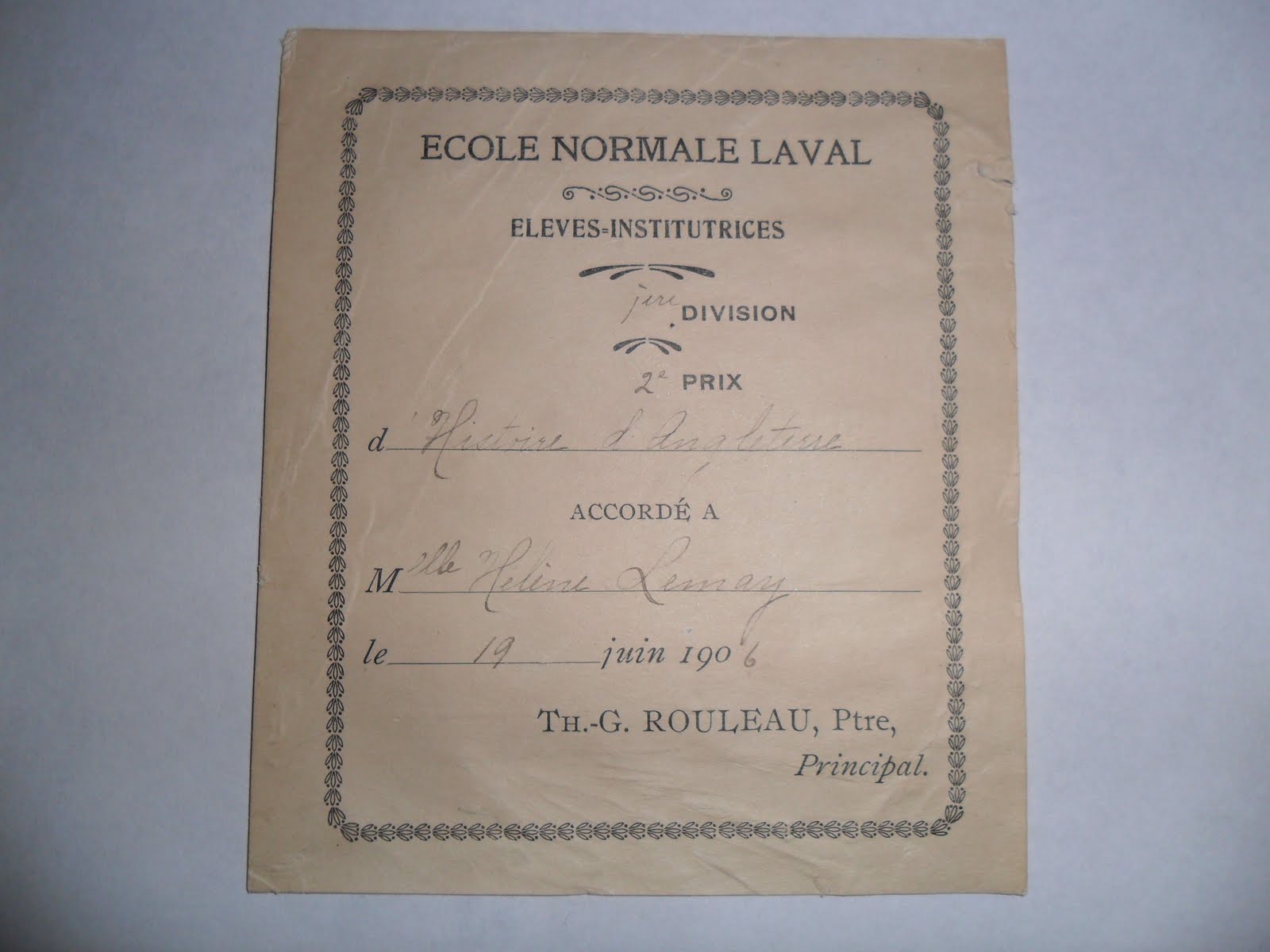
Prize bookplate for Ecole Normal Laval

Prize bookplates - or what some people might call decorative bookplates - are commonly found in old Canadian text and reference books from the early 20th century.  I recently discovered this bookplate from the Ecole Normale Laval, awarded to Mademoiselle Helene Lemay on 19 June 1906 as a second prize in the first division of studies.

The Ecole Normal Laval was situated in Quebec City at the location of the old residence of the British Governor of the province of Quebec, Sir Frederick Haldimand (1718-1791).  He had originally built here opposite the old Castle Saint-Louis in the late eighteen century, but this building was later destroyed by fire in 1834.  It was replaced soon after with a terrace, and then in 1837, with a new building that housed a teacher training school.  This later became the Ecole Normale Laval.  In 1969, it merged with the Jesuit College to become the new Collège François-Xavier-Garneau.

Ecole Normale Laval c.1900


Unfortunately, I don't know much else about the prize recipient at present and the scrappy old book from which the plate came didn't offer any further clues.  Nevertheless, I still think prize and decorative bookplates are an interesting sub-genre of the hobby and shouldn't be overlooked.  After all, for someone over a century ago, this ex libris held a very special significance.