Showing posts with label Ex Libris. Show all posts

Sunday, 17 February 2013

The Right Honourable Vincent Massey PC CH CC CD

Rt. Hon. Vincent Massey (1887-1967)
There have been 28 Governors General (GG) of Canada since Canadian confederation in 1867 and I am happy to have in my collection bookplates for most of these gentlemen.  I've blogged before about GG ex libris but a recent inquiry this week has prompted me to write this time about Charles Vincent Massey, the 18th GG of Canada.

Born into an influential and wealthy Toronto family, he earned degrees at the University of Toronto as well as Oxford University before going into public service.  Massey served in uniform during the First World War as a commissioned officer working for the Cabinet War Committee, but otherwise had limited military service before returning to civilian life after the end of the war.  In 1918 he created the Massey Foundation that supported, among other things, the development of new architecture and building in Toronto.  Massey continued to pursue both business and philanthropy until 1925, when through the connections of friends he returned to public service being appointed to the King's Privy Council.  He was subsequently made a minister without portfolio in the Cabinet of family friend Prime Minister Mackenzie King.  Though he failed to secure a seat in parliament through election, he was still included as a special observer to the 1926 Imperial Conference before accepting an appointment as the Canadian ambassador to the United States.  Massey's diplomatic and public service career spanned over 25 years, until his appointment as the first Canadian-born Governor General on 1 February 1952.

Bookplate for Massey the diplomat
This armorial bookplate belonging to Vincent Massey is a personal favourite in my GG collection, and was designed for him by Alexander Scott Carter in 1913.  It is adorned with the shields of Massey's alma maters, University College (University of Toronto) and Balliol College, University of Oxford.  The tree also signifies learning; it may have been commissioned to mark Massey's appointment as the Dean of Men at Burwash Hall, and also a lecturer on modern history at Victoria University.  The composition is typical of Carter's approach to design during that period, as he worked to modernize the traditional coats of arms ex libris in a manner that retained a style of richness appropriate to the ladies and gentlemen he was crafting for.  His accomplishment in architectural decoration and heraldic ornament would eventually earn him accolades across Canada, the United States, and the United Kingdom.

This bookplate is listed in Prescott (p.94), however, it's date of design/issue is wrongly identified as 1918.  A close examination of the bookplate itself in fact reveals the date 1913 in two places; on the upper right arm of the banner in roman numerals, and also, following Carter's signature at the lower right just above Vincent Massey's name scroll.  One might assume, however, that Massey used this as his main bookplate from 1913 to approximately 1925, when his appointment to government may have prompted the design of a new ex libris.

It's no surprise that Carter designed this bookplate.  Massey's family made considerable donations to the University of Toronto's improvement during the First World War era, including the building that eventually became Hart House in 1918.  Carter was the main heraldic artist commissioned to execute the interior design and decoration.  Perhaps it was the execution of this bookplate that helped him land the job, it's a remarkable piece of miniature art.  Until next time... 


Tuesday, 22 January 2013

Rest Your Shield Now and Again

Remember to rest your shield now and again
It's a rather busy time at the moment with several other writing projects on the go, and I spent my weekend toiling away to meet a scholarly publisher's deadline instead of digging through the boxes of bookplates and other book related ephemera that patiently awaits my attention.  As I'm unlikely to get away from work to write up a proper blog this week, I thought I'd just share a bookplate with you that I've currently set on my desk.  This little ex libris reminds me that at some point everyone should rest their shield for a moment and take a break.  As one who researches and writes extensively every day in my career, it's easy to forget this.  It's a good reminder for me - it's good for your physical and mental health, and gives you the energy needed to return to the work at hand.

I've liked this ex libris for other reasons as well, and appreciate its unconventional approach to displaying a family coat of arms.  If you have a bookplate that makes you think, please feel free to share it with me.  Perhaps we can post some other people's favourites up here on the site.  Until next time....    

Sunday, 6 January 2013

Bookplate Designer Sylvia Hahn (1911-2001)

Bookplate designer Sylvia Hahn
Happy New Year everyone, I hope you had a safe and enjoyable holiday season.

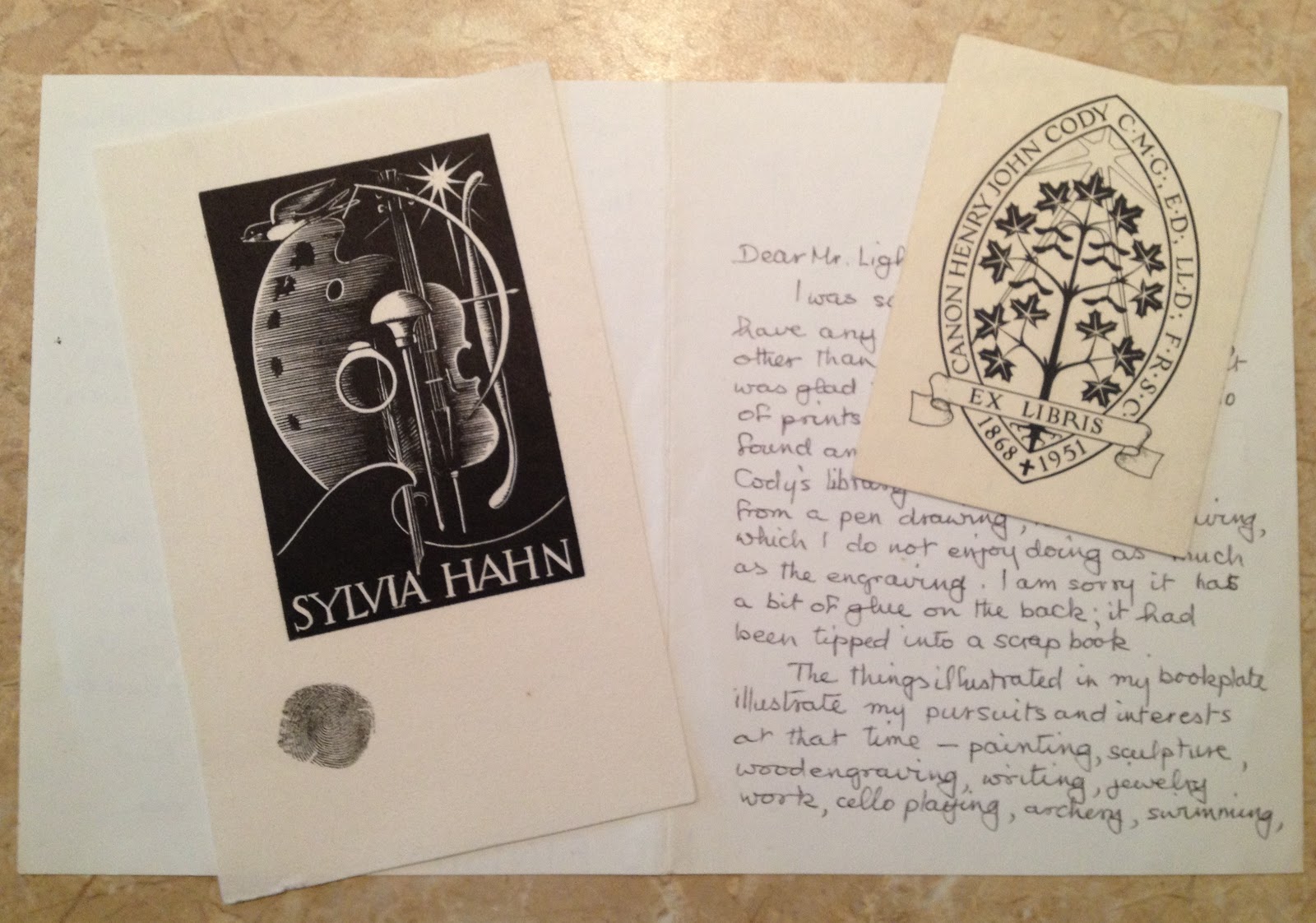
Occasionally in this hobby I come across little groups of letters and related bookplates like the one pictured here.  This particular lot consisted of two bookplates and a letter attributed to Canadian artist Sylvia Hahn.  Born in Toronto in 1911, she was an exceptionally talented and versatile craftswoman who was awarded the Governor General's Gold Medal for artistic achievement in 1932.  She then went on to a very successful career with the Royal Ontario Museum where she was a prolific painter, illustrator, engraver, designer, restorer, and writer.

Sylvia Hahn's personal bookplate
Hahn's design work included bookplates, which she often executed from wood engravings and pen and ink drawings.  A more complete biography of Hahn's extensive achievements may be found in the Canadian Women Artists History Initiative, but I'd like to include a short excerpt from the letter shown above (written in 1984), which offers some insight to Hahn's own bookplate design:
The things illustrated in my bookplate illustrate my pursuits and interests at that time - painting, sculpture, wood engraving, writing, jewellery work, cello playing, archery, swimming, astronomy, and the study of barn swallows.  I am afraid if I designed in again now the composition would be a bit emptier.  As one gets older it seems there is less time in a day for doing things!

She also pointed out that the medium employed on her own bookplate was wood engraving not wood cut:  "We engravers feel strongly on the subject - not that cuts aren't just as good, but they are different."


Hahn in her studio - date unknown
I feel lucky to have gotten this ex libris for my collection.  According to the letter, Hahn only made one printing of her bookplates and had run out of them save for this one that was tucked away "in my portfolio of prints and reproductions."

The other bookplate shown above was also designed by Hahn, for Canon Henry John Cody CMG, the 6th President of the University of Toronto.  I've already identified a few other bookplates designed by her as well, but further research is still needed before I can construct a complete catalogue of her ex libris work.

If you know of any other bookplates designed by Sylvia Hahn, I'd love to hear about them, just use the email above.  Otherwise, I encourage you to explore her work beyond her bookplates as well - her paintings and other illustrations show great talent and are an enjoyment.  Until next time...


Sunday, 23 December 2012

Thomas Aylwin - Merchant of the Seven Years War


Modern day Rue Notre Dame, Quebec City
Bookplates offer a tremendous opportunity to study those men and women who laid the foundations of the country we live in today.  Thomas Aylwin, an English merchant who conducted trade in Quebec City after its capture by General Wolfe’s army in 1759-60, and then in Boston until the American revolution broke out, had this beautiful Chippendale armorial bookplate made for his bibliographic possessions. 

Aylwin was born in Romsey, Hampshire, England in 1729.  He pursued a merchant’s life and eventually established himself at Quebec City after its capture from the French by General Wolfe’s army in 1759-60.   As one biography of him noted, “he was doubtless among that set of merchants of whom Governor Murray said in 1764: they have resorted to a Country where there is no money, and . . . think themselves superior in rank and fortune to the Soldier and the Canadian.”  At Quebec City, Aylwin’s partner was Charles Kerr and the two men specialized in the retail sale of imported products including dry goods, foodstuffs, wine, hardware, stationery, and other merchandise. After Charles Kerr died in 1765, Aylwin carried on at Quebec until about 1769.  After that, records indicate he moved to Boston, where he continued to operate as a merchant until the outbreak of the American Revolution.  Along the way he had married Lucy Cushing, daughter of the US Supreme Court Justice William Cushing, on 11 September 1771.  Together they had three sons. 
Thomas Aylwin's book plate

Fleeing the outbreak of war, Aylwin returned to Quebec City with his family in 1776 and set up a new business on Rue Saint-Jean, later renting a house on Rue Saint-Joseph. On 23 October 1777 he bought two houses on Rue Notre-Dame, in the business district, from merchant and legislative councilor Thomas Dunn for £948.  Over time the range of products he advertised in the Quebec Gazette steadily broadened.  He died at Quebec City on 11 April 1791.  Throughout his life Aylwin seems to have enjoyed moderate prosperity, and the inventory made after his death reveals that he lived comfortably, though not in luxury.  Included in this inventory was the record of a library of some fifty volumes that included works of history, law, religion, and poetry, as well as business.

I secured Aylwin’s bookplate amongst a small collection of heraldry items I bought earlier this year.  Interestingly it was not listed in the famous Franks collection catalogue, but it was listed in the 1895 catalogue of Canadian bookplates assembled by Quebec Ex Libris authority Phileas Gagnon (G.4755 and G.S. Appx).  Given that his estate noted that Aylwin owned “some fifty volumes” I can’t help but wonder just how many of these bookplates have actually survived over the last 250 years.  Is this the last one?  Does anyone else have one of these in their bookplate collection?  If you do please let me know.  Until next time …

Friday, 22 July 2011

The Eatons

Timothy Eaton (1834-1907)
When Timothy Eaton sold his small dry good business in 1869 and opened a new general purpose and Haberdashery, he probably did not realize that he had embarked on a path that would make his name a common household brand, as well as one of the largest department store and retailers in Canadian history.

Needless to say, the Eaton family were the holders of substantial libraries and produced a number of bookplates for their collections.  The Phillipe Masson Ex Libris collection at McGill University has a number of the Eaton family bookplates in their collection.  I recently acquired one for my own collection from fellow collector Lew Jaffe who writes the ' Confessions of a Bookplate Junkie' blog.  This led me to explore not only the history behind the Eaton's empire, but also their libraries.  The result was a plethora of interesting and diverse pictorial and armourial bookplates.  In no particular order I've included a number of these below.


As you can see there was a broad diversity not only in the style of bookplate (pictorial, armourial, labels, and memorial) but also the composition.  Lady Eaton's full colour bookplate is an interesting departure from the others, for example.  As of note are the clearly Canadian icons - the maple leaf, the beaver - all of these are the hallmarks of a legendary Canadian family.